

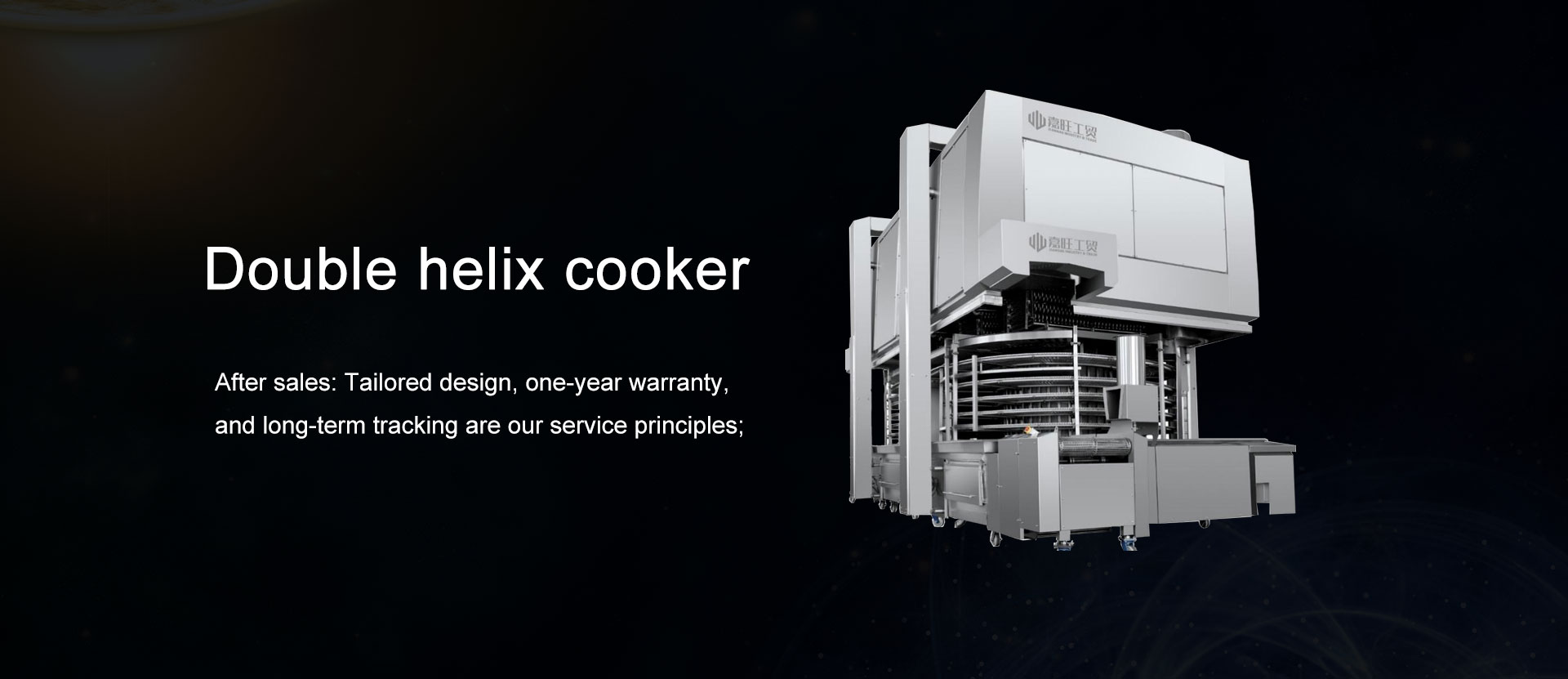
Automatic Double Spiral Cooker: How It Improves Cooking Uniformity and Line Capacity
For technical evaluators in bakery processing, an automatic double spiral cooker offers a practical way to improve product consistency while expanding throughput within limited floor space. By combining controlled heat transfer, continuous movement, and stable residence time, this equipment helps reduce uneven cooking and supports higher line capacity. It is especially valuable for manufacturers seeking reliable integration with frying, steaming, or baking systems in modern production lines.
The main reason this equipment attracts attention is not simply that it is continuous. Many continuous cookers still struggle with edge-to-center variation, unstable dwell time, or poor line balancing upstream and downstream. The value of an automatic double spiral cooker lies in how it manages product movement and thermal exposure at the same time. For technical review teams, that is the real evaluation point: whether the machine can deliver repeatable cooking performance under actual production conditions, not just under nominal design capacity.
Why the double spiral format improves cooking uniformity
In bakery and snack processing, non-uniform cooking often comes from three linked problems: inconsistent product loading, uneven heat distribution, and variable residence time. A double spiral design addresses these by moving product in a controlled path over multiple tiers while maintaining a compact footprint. Compared with simpler linear transfer systems, the spiral path extends effective processing length without demanding a longer line.
Uniformity improves when three conditions are stable:
- product spacing remains consistent on the conveyor,
- heat transfer is distributed evenly across the product bed,
- residence time variation stays low from batch to batch.
In practice, this matters for products where surface setting and internal moisture migration must stay balanced. If thermal input is too aggressive at the outer layer, the product may show acceptable color but poor internal texture. If transfer is too weak or unstable, the opposite happens: undercooked core, excess moisture retention, and downstream instability during cooling or packaging.
The spiral arrangement can reduce these risks because product movement is continuous and predictable. In systems using steam, hot air, or mixed thermal modes, that predictability supports better control of heat penetration. The result is often tighter process repeatability rather than simply “faster cooking.”
How it increases line capacity without simply raising speed
Capacity gains are frequently misunderstood. Higher throughput does not come only from increasing belt speed. In many bakery applications, pushing speed too far shortens thermal exposure and forces compensating temperature increases, which can damage quality. A better capacity strategy is to maintain the required cook profile while increasing usable process path length per square meter of plant space.
This is where the double spiral layout has an operational advantage. It creates a long processing route vertically, allowing more product to remain in the cooker at any given time. For facilities constrained by building width or by existing line layout, this can be more practical than extending a tunnel system.
Technical evaluators should therefore look at line capacity in terms of:
- actual kilograms per hour at target product quality,
- allowable product loading density on the belt,
- time required for thermal equilibrium after startup or recipe change,
- interaction with upstream feeding and downstream discharge equipment.
A machine may look efficient on paper but still become the bottleneck if infeed distribution is poor or if discharge temperature causes issues in subsequent frying, baking, or packaging stages.
Critical evaluation points beyond nominal specifications
When reviewing an automatic double spiral cooker, the most useful questions are usually not in the sales sheet. Temperature range, installed power, and dimensions are basic inputs, but they do not reveal process stability. More important are the details of airflow or steam distribution, conveyor tension control, sanitation design, and automation response.
Residence time control should be examined carefully. Even small fluctuations can affect color development, moisture loss, and texture consistency. For bakery processors handling sensitive dough-based or pre-formed products, this becomes a quality risk rather than a minor operational issue.
Another practical issue is cleaning accessibility. Spiral systems are space-efficient, but compact geometry can make sanitation more difficult if drainage, belt access, or condensate management are poorly designed. In steam-based applications, condensate control is especially important because uncontrolled moisture accumulation can change thermal conditions and increase microbiological risk. In some lines, a supporting unit such as a Steam cabinet may also be considered where staged thermal treatment or holding is needed before or after the main cooker.
Integration risk is often higher than equipment risk
For most projects, the machine itself is not the hardest part. Integration is. A cooker that performs well in isolation may still fail to meet line expectations if the product arrives with unstable weight, irregular shape, or inconsistent surface moisture. The same applies downstream: if the cooker discharges product with too much residual heat or moisture, later stages may see yield loss or packaging defects.
This is why technical assessment should include the full process window. Check whether the control system can coordinate with upstream proofing, steaming, frying, or baking sections. Review sensor placement, recipe management, alarm logic, and recovery behavior after stoppages. The line needs more than throughput; it needs controlled throughput.
In applications where thermal staging is part of the process design, equipment combinations may matter more than any single unit. A Steam cabinet, for example, may support process balancing in lines where moisture conditioning and final cook development must be separated for quality reasons.
What technical teams should conclude
An automatic double spiral cooker is worth serious consideration when the production target requires better uniformity, higher output in limited space, and stable integration with continuous bakery processing. Its strongest advantage is not that it is more complex, but that it can maintain a controlled thermal path over a larger in-process volume.
The correct evaluation standard is straightforward: can it hold product quality at the intended line rate, under realistic loading conditions, with acceptable sanitation and control performance? If the answer is yes, the equipment is not just a cooker upgrade. It becomes a line-capacity and consistency tool, which is usually the more important decision in modern bakery manufacturing.
Online Consultation